19/2/2026 Tonga day tour
- Claire

- Feb 20
- 20 min read
Good morning from sunny Tonga, I'm not going to lie to you, but it was a real struggle dragging myself out of bed this morning. Everything is aching like a massive achy thing and moving isn't as easy as it has been. A soak in the tub feels like a great idea but I'm not sure how I'm going to get out of it once I'm finished and the embarrassment of having to call for help is one I can well do without at the moment.
Sounds of breakfast being made filtered through my door and with my mouth watering I made my way to the kitchen dining room. The table was already set for 5 people but I was the first one up. Maria, the owner of the hotel, introduced herself and I was able to pay her for my accommodation. I was introduced to Me’me, a beautiful Fijiian lady who was cooking breakfast and to Maria's daughter, as well as the young man who was driving me yesterday, whose name I can't pronounce unfortunately. I was made a cup of coffee which I took outside onto the veranda to drink so I could look at the ocean and it was like a millpond, not so much as a ripple on the surface.

Breakfast consisted of toasted tuna and onion sandwiches flavoured with herbs and spices. Fried eggs, homemade Fijiian bread, loaf cake, watermelon, banana and papaya, and a delicious avocado and lettuce salad with a rich and tasty creamy dressing accompanied by a delicious coffee.

I was joined by a young man from India who is over here doing computer programming for a month. He has only been married for 7 months and has left his wife at home which must be difficult for him
Halama, my tour guide arrived in a taxi at just after 0900 and after a quick introduction to his cousin Deli who was driving us for the day we got going. My Hotel , the Paradise hotel is located on the Hala Vuna road which follows the ocean right down to the end of the city. Halama is an American Tongan, he was born here and his family emigrated to America when he was around 8. He came back to Tonga, giving up a well paid job in the states to get back to his roots which he is very proud of. He has now been back here 16 years and probably won't ever return to the states. He’s very knowledgeable on the Island and his perfect English and Tongan makes it very easy for him to impart his knowledge. He took me down to the end of the city and showed me the aftermath of the Tsunami that hit Tonga in 2022 after a volcano erupted . The tsunami caused massive destruction of homes and infrastructure and around 3000 people were left displaced, he is one of them. As his home was wiped out in the tsunami and he lost everything, he now lives in a tent and is struggling to get the displacement help that has been offered to the Tongan people. Nepotism is very much alive and well in Tonga and the people who know people have been compensated in some form. Also verified identification was required to actually get the compensation and Given that the majority of people had lost everything in the tsunami, I'm guessing that was difficult for them to produce. 85% of the country was affected and were left without vital services, but fortunately only three lost their lives. The trauma from the day still lives on within the children who have nightmares ,and there isn't a huge support system, very little counselling etc to help them through it. Families who lived on farms in the outer Islands are now living in government provided one bedroom homes on the main island Tongatapu, where I am staying. Many of the islands that were most badly affected won't be rebuilt, the homes and farms stand abandoned and the inhabitants have mostly been relocated to the big Islands. Many did not and still do not want to leave, and there is one island that still has 50 people living on it, with no electricity but they have rebuilt their homes as best they can and continue to live there. The government is trying to make them leave but they are refusing to do so. Along the road side were little tables set up, the fishermen who had been out fishing the night before were selling their catch. It felt wrong to be taking their pictures out of the window although I did ballet one of a boy in a swing which I absolutely love, and one of a tractor that Si would have called “cliffy porn”


There is a lot of poverty on the Island but there is also some beautiful rebuilding which really confuses me, this was explained later and Tonga has a debt of millions of US dollars to china, and it is chinese investment that has paid for the roads, the pavements and the rebuilding of some of the tsunami hit tourism properties. My hotel is one of those that has been rebuilt, the. Old building is still there behind it.

China was instrumental in providing loans after the 2006 pro democracy riots which saw the whole of Tonga’s business district burnt to the ground.. Because Tonga is prone to frequent climate disasters the country has been left with no choice to seek financial assistance from China.

Tonga is the only pacific island nation that has never been colonised and its Monarchy is an hereditary one, the current king holds absolute power, despite having a democratic elected government. The Palace is set amongst lush gardens and backs onto the ocean. It is surrounded by fencing and walls and visitors are not allowed to enter. The flag was flying today which means King Taufa’ahau Tupo was in residence.

Opposite the palace was a government building that was rebuilt using Chinese money, and there is a large and very prominent plaque right in front of the fountain that says so. It kind of feels to me that Tonga is no longer the only Pacific nation not to have been colonised.

From the water front we circled around the palace
and drove through town towards the Royal tombs stopping for a snack break, fresh donuts dipped in icing sugar and large bottles of water.


We ate as we drove, and hopped out of the car, munching on a sweet sugary donut and walked to the fenced off tombs they are in lush green park land and no one is allowed in them . The tombs are for the royal family and each one has a statue on the top of them of the deceased monarch.

The country's most famous monarch was Queen Salote Tupou III who ruled Tonga from 1918 until her death in 1965.
From the Antrim Guardian,
“At the coronation of Queen Elizabeth II, she arrived in an open carriage accompanied by a tiny man in frock coat and spats. Noel Coward, upon being asked who the man might be, famously responded: “That's her lunch.” The Queen was 6 foot 3
In a 1999 edition of Overseas magazine, Stanley Martin looked back at the Queen who won the hearts of a generation of British people with her rainy ride in the Coronation procession of Queen Elizabeth II on 2 June 1953.
Mr Martin eloquently explained her rapid rise to popularity and how she captured the hearts of the public and became a celebrity in her own right.
Yet again, rain was involved.
He wrote: “As a schoolboy, I watched the procession from the front row of the crowd in The Mall, where I had slept overnight, and woke to the news of the ascent of Everest by Hillary and Tenzing.
“In fact, the procession was made up of several small processions, including that of the ‘Colonial Rulers’; all ‘Highnesses’, except for the ‘Majesty’ of the Queen of Tonga, with an appropriate majestic figure and bearing.
“She sat in the first carriage, opposite the Sultan of Kelantan. On the way to Westminster Abbey, in the morning, all the carriages were open. On the return from the abbey, in the afternoon, it rained heavily and the only open carriage was that of the queen and the sultan.
“Whereas His Highness got very wet, Her Majesty was partly protected by the ample pink silk mantle of a Dame Grand Cross of the Order of the British Empire (GBE), which proved to be an effective raincoat. She had no umbrella, however, and must therefore have finished with soaking wet hair.
“The press was ecstatic and Queen Salote became a household name overnight. June babies were christened Charlotte (of which Salote is the Polynesian form), a racehorse was named after her and she was the subject of topical songs: ‘Linger longer, Queen of Tonga’.
“The Manchester Guardian wrote of ‘the magnificence of Her Majesty the Queen of Tonga, smiling broadly in a spiteful downpour and heartily waving a powerful bare arm, happy as though all the sun of the friendly islands were beating down’.
“The Daily Telegraph reported that she received the biggest cheers of the day, except for The Queen herself and Sir Winston Churchill and that, later, a woman went up to her car in Knightsbridge and called out ‘Good luck. You were marvellous’.
“The Telegraph concluded that ‘Queen Salote, whose genial dignity matches her proportions, has won an extraordinary quantity of affection from the British people’. The Times described her as ‘the outstanding overseas figure of the celebrations’.
Overseas told how Queen Salote Tupou III was educated at the Diocesan High School for Girls in Auckland and succeeded her father, King George Tupou III, at the age of 18 - in 1918.
“ In the previous year, she had married her cousin, Prince Uilami (William) Tungi, who served as Prime Minister from 1923 until his death in 1941. In the Second World War, the resources of small Tonga were put at the Allied disposal: three Spitfires were paid for by the Tongan people and a detachment served in the Solomon Islands.
“Queen Salote received every honour that the monarch of the United Kingdom could confer on her.
“She was made a Dame Commander of the Order of the British Empire (DBE) in 1932 and promoted, in 1945, to be a Dame Grand Cross, thus providing her with that pink mantle that was to be so useful eight years later.
When Queen Elizabeth II visited Tonga during her extensive Commonwealth tour towards the end of 1953, she made Queen Salote a Dame Grand Cross of the Royal Victorian Order (GCVO). In 1965, the Order of Saint Michael and Saint George was opened to women and, shortly before her death in that year, Queen Salote was made the first Dame Grand Cross (GCMG).
“Her death caused great sadness in Tonga, the South Pacific, New Zealand (her second home), and Britain. Diabetes, pleurisy and, finally, cancer had gradually overcome her.
“It was a sick woman who sat on the veranda of the palace in Nuku'alofa on 30 July 1965 to watch the parade celebrating the longest reign in Tongan history. Her great, great grandfather King George Tupou I, had embraced Christianity before reigning from 1845 to 1893; the 'Grand Old Man of the Pacific' died at the age of 96.
“His great grandson and successor, King George Tupou II (Queen Salote's father), concluded the Treaty of Friendship and Protection with Britain in 1900, whereby the Friendly Islands (so named by Captain Cook) remained an independent kingdom under British protection.
“In early November 1965, Queen Salote, accompanied by her younger son, was flown in an RAF aircraft to Auckland for hospital treatment. A month later, her condition deteriorated and she died on 16 December, an hour before her elder son, because of aircraft delays, was able to reach her bedside.
“The funeral took place in Nuku'alofa on 23 December, following a lying-in-state characterised by the special Tongan high ritual of chiefly death: Koe takipo.
“Fires burned continually throughout the hours of darkness around the palace, with three attendants sitting on three of each burning torch. One attendant held the torch horizontally in the direction the body lay while the other two knocked away the ash to keep the torch burning. For the same period, no food could be prepared inside the palace itself or the grounds and only the new king could eat in the palace, from food cooked outside it.
“The population of Nuku'alofa was doubled by mourners from the outlying islands, bearing gifts of food, mats and bark cloths for their new ruler.
More than 200 men carried the bier from the palace to the royal tombs where the later rites were conducted, according to custom, behind a closed wall of bark cloth screen 150 metres long around the whole tomb.
“Queen Elizabeth II was represented at the funeral by the Governor-General of New Zealand and flags flew at half-mast in London on that day.
The links of the Tongan royal family with Britain have been firmly maintained since Queen Salote’'s death.
“ Her elder son and successor, King Taufa'ahau Tupou IV, was a frequent visitor and was present at Queen Elizabeth II's Silver Jubilee Service in St Paul's Cathedral in June 1977, seated on a large Tudor-style chair originally made for 'Henry VIII' in the TV series 'Elizabeth R'.
The article concluded: “The relationship between the Friendly Islands and Britain continues vigorously today but never was better symbolised than by a smiling, wet Queen Salote in 1953.”
While we were at the Royal tombs, and admiring the church that was opposite them, that has still to have the roof repaired, although the roads and pavements outside are immaculate,


I was distracted ( not like me) by the most incredible singing, it was breathtaking and brought a huge lump to my throat. I looked around trying to see where it had come from and Halama said it was from the girls school. He said we could go and visit and listen. I was taken aback, can you imagine the reaction we'd have at home if a random foreigner turned up at an only girls school to listen to the singing. Free ride in a police car! Not here. We were welcomed in by the Principal, and caught the end of the last song. She invited me back on monday, to listen to the girls again and said i would be allowed to take photos which again blew my mind. The girls were delightful and all happy smiling and waving at me, so unlike home. I felt very emotional coming from there, the music and singing had hit me hard, just beautiful. They are practicing for the king's birthday celebration next month. The school is a private one and costs 300 TOP, about £100 a year, which is a lot of money here to send the girls to be educated. There are other private church schools and if you can't afford the fees, if you volunteer to paint, do maintenance work and attend to the grounds your child can be educated for free. If you only have one child the fees are manageable but the Tongans have large families, so it gets very expensive for them. I really hope that i can get to the school on monday to hear that singing.

We passed by the Theological college which is where the boys go if they wish to become priests. The stone wall had toppers on them that were draped in purple cloth with ribbons which signify a death and the mourning period.


As we travelled around the Island I saw many of them in varying shades of purple, and also several funerals. Traditional funeral attire is all black clothing and a woven ta’ovala mat. The type of mat worn indicates how the mourner is related to the deceased. Someone wearing a colourful fine woven mat to the funeral indicates high status, the highest status goes to the father’s oldest sister called the Fahu. a younger brother would wear the dirtiest worn out mat. Immediate family members generally wear worn or frayed ta’ovala to show love and respect for the deceased , their grief is also sometimes represented by the size of the ta’ovala. It is considered deeply disrespectful to wear black in Tonga if you're not grieving.
As soon as the death has occurred all family members will be notified, nowadays often by a radio message, and they are supposed to come to the putu (funeral rites). In Tongan culture no excuses are accepted for missing these rites. For friends or distantly related members it is enough that they come, pay their respect to the dead, bring a small gift for the widow (or close relatives), have their share of food and then leave until the actual burial. The household of the deceased is supposed to provide a meal, or meals if the funeral is long, to all mourners. In the case of a large family, this is a huge and expensive operation with a big ʻumu, and much food.
Closer family will bring huge ngatu, the Tongan word for the hand painted tapa cloth, other traditional gifts, and are supposed to stay for the ʻapō (night vigil). Usually a big tent (some companies are specialised in hiring out such tents) is erected in the garden, and there the people sit the whole night singing religious songs. This is normally one night, but in case of a high chief the ʻapō can last a whole week.
The burial itself starts with a church service, the number of reverends/priests, the number of their sermons and therefore the duration of the service is proportional to the rank of the deceased. After that all will parade to that cemetery where the family has a piece of ground. A brass-band may lead the procession. If the deceased is a high ranking civil servant, it will be the police brass-band.
Meanwhile, men and boys of the family have dug a grave, and the coffin is lowered in there. Nowadays the grave is usually sealed with concrete. After that, all leave, although the closest relatives may stay at the grave for the next 10 days.
We drove past the Health care centre and Hamala told me that basic healthcare is free in Tonga but not for specialists or consultants, they are only now installing the first dialysis machine in the hospital. The largest cause of death on the islands is obesity and diabetes and although there are no fast food outlets as the country has refused to have them, the diet is poor, very high in fats and white carbohydrates. The traditional island diet has moved away from a simple diet of freshly caught fish and home grown vegetables to processed foods and heavy red meats (which i love) all cooked in the natural fats, pork and lamb being the most popular foods and they just adore the fats.


The weather held off beautifully as we drove around and out next stop was Abel Tasman's landing site.

Again the knock on effect of the tsunami was evident. The King has forbidden any rebuilding of the holiday resorts on the Island and as such the sites are now overgrown and derelict. There was a half finished building looking out of the most fantastic view of the island opposite, with great eaves and crystal clear waters.


The island opposite, is the one that still has 50 people living on it and the king is trying his best to get them off there. Hamala suspects it's because the island is being eyed up as a resort. However they are holding firm and refusing to leave.

The person who has built the now abandoned building planned to make it into a restaurant so he could sell locally made food and products to visitors to the abel tasman point. Unfortunately he is now left with a giant white elephant and land that he is forbidden to build on or develop.
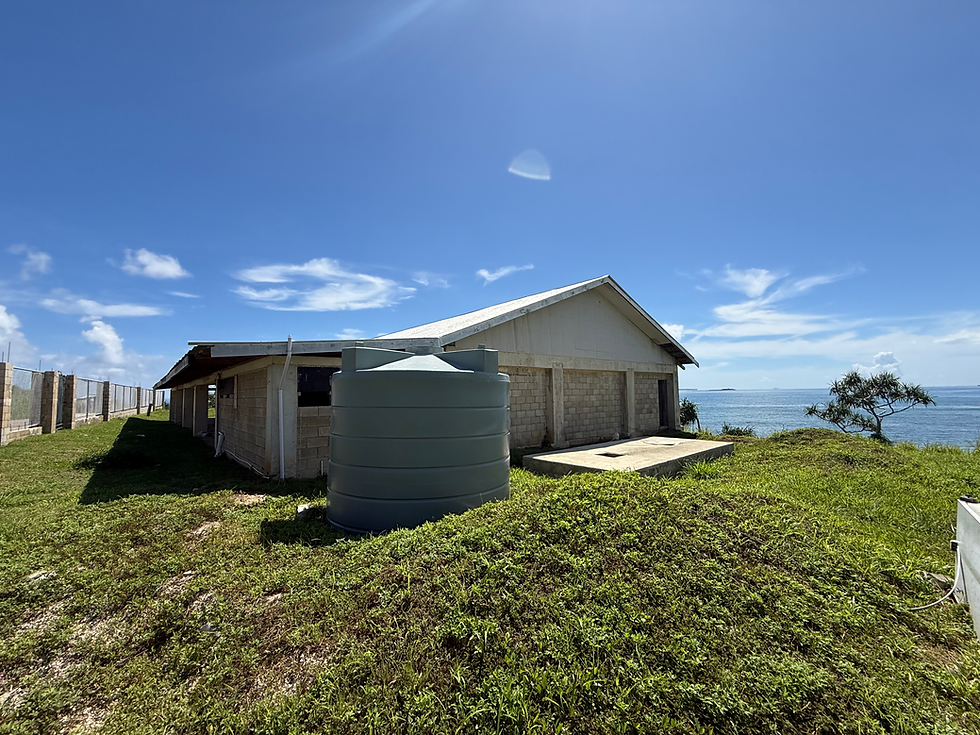
Any resorts on the west side of the island that were taken out in the tsunami are all the same, they are not allowed to rebuild. The families have received no compensation for their losses and are stuck with land they can't rebuild on. Hamala's aunt owned a resort on the west coast, and lost everything , she is now suffering with ill health and has moved to america and the stress of it all is impacting her health as you would imagine. Her family have had to leave the island as their livelihood is gone and again, halama thinks it will be just a matter of time before a sum of money is offered to them to sell it. The location is beautiful, pure white sands, crystal clear waters, great surfing and snorkeling, although obviously the reef was smashed and destroyed in the tsunami, but still there is so much that could be done with the area.


It's such a shame the king is refusing to rebuild, particularly during the whale season when there isn't enough accommodation for the number of guests who want to swim with them. Iwas really surprised that the coconut trees have regrown so fast, and it turns out, they withstood the tsunami perfectly. The mango trees and a lot of other native trees didn't, but the good old coconut nailed it. It helped the land owners a little but, because the bush was taken out, its allowed them to cultivate the ground for crops in some places so there is a silver lining, a really small one!

Our next stop was the cemetery, to see the flying foxes. All around the island people are trying to deter the flying foxes because they decimate the fruit trees. Unfortunately they are protected and it's all out war with them. They are bloody huge bats just hanging upside down from the trees in the cemetery, not sure why they are there and so noisy, particularly at night when youre trying to sleep!


The main crops grown in Tonga are Taro, cassava coconuts, bananas, watermelon and pineapples and all along the road side are fields full of the crops.


Passing by many of them we came to Tsunami rock, up a little tiny road, which has just had the verges cut back making the road wider, we came to a track.

The driver stopped at the end of it and we had to walk the rest of the way, again, given its a major tourist spot there is nothing done wit hit to make it easy to get to or even that welcoming https://tongatourguide.com/tsunami-rock Its a stunning bit of rock, and there is even a coconut tree growing out of it, when your walk around it you can see the fossilized corals in it and every inch if it is something different, just beautiful its a long way from the ocean too, and the power of the water to get it to where it is must have been incredible. Like i say they just dont seem to want to make it accessible which to me is such a shame.


From the rock we travelled to Houma and the blow holes. The sun was burning the back of my neck and there was a man there making jewellery and some of it was really pretty. I bought some earrings and a coral necklace from him. He was massive but truly delightful. The blow holes were pretty special, and I even saw turtles. They now close them off at night because its used as a drinking area and there are no coastguard or rescue boats on that side of the island so if you go in you come out as minced beef, clearly I was not going to be dipping my toe in there thankyou.


We stayed a while watching the waves and they soothed my soul . the one wave was so big all I managed to get when I took the photo was spray. We stayed and just atched for about 15 minutes before getting back in the car and going ot he three headed coconut tree. Something of a celebrity on the island. it s the only one that has three heads.

However, there were the purple drapes around the fencing of the property, and the driver noted that someone has cut around the bottom of the trunk and its now dying off, the one head is already dead. The conclusiin from the driver was that the new heit to the property no longer wants the tourists there and wants it gone. Hamalas is going to report it to the tourism industry, although i don't know what they will do about it if anything.
Leaving the three headed coconut tree we headed back into town to pick up lunch from one of the restaurants. I had the raw fish and cassava root, and the others had umu, the meat wrapped in taro leaves.

I didn't risk it for the high possibility it would be lamb!. Ugh , you can taste the wool. We had cold orange squash too, which was a surprise and something I've not had in a very long time, but was still refreshing. We took out food and headed east to the Ha’amonga which is described on the map as being a Maui trilithon
There are several legends relating to it but the above from good old wikipedia is pretty good.
We ate our lunch at the covered picnic tables and enjoyed the cool breeze. The temperature had crept up in some style and I was beginning to melt. Once wed finished lunch, i couldnt eat all mine hamal said he'd give it to the the man selling trinkets and souvenirs at the site, i was worried about offending him but i t would have been more offensive to have wasted it and thrown it away, i didnt feel to bad about not eating it all. It was delicious and I've developed quite a liking for it now. I know who I am with the raw fish!.


We walked around the stone henge and again I was fascinated with the fossilised corals and more so the puzzle as to how the hell it got there and was constructed. Mightily impressive. Just below it underneath a rain tree, there is another tomb which we went to see, and I spotted several bee nests in the tree.

The tongans hate the bees, and prefer to destroy the nests rather than encourage them. They don't understand the importance of the bees. Thankfully because they were high up in the tree they were safe enough.

Stating to struggle by now from the heat and also just because, we followed the ocean road back towards the town searching for fishing pigs, unfortunately I didn't see any and I was a bit gutted. I do love me as a pig. I was rewarded with them crossing the road in front of us.

They generally fish the beaches at low tide, snuffling through the shallows for the clams and other shell fish they clearly love. I'm hopeful of seeing one opposite the hotel as they are there too sometimes, only at low tide. I shall be keeping my eyes peeled. And no they are not dressed in waders and holding fishing rods which is what Si would have said. Despite not seeing the pigs the coastline was lovely.


Our next stop was Captain Cook's landing point, a lagoon area surrounded by mangroves which has made the water slightly unattractive. It's not advisable to swim there, but you can see the clear ocean just beyond it.

We had got back in the car and it started to pour with rain, and omg did it ever train, it did cool things down a bit, the temp hit 36* so it's been a bit sticky. Even in the rain the Kingdom is stunning, and by the time we'd driven less than half a mile it had stopped and the sun came back out. We passed the Tonga police headquarters, which were all fenced off, and also the training school.


There were a lot of expensive looking cars behind the fences and they were ones that had been seized from the drug dealers. Addiction is a massive problem on the island, drugs, alcohol and eating believe it or not. .
There is a prison but its is completely open no fences at all which was incredible, a lot of crimes go unreported particularily rapes and sexual abuse becuase of the shame it brings to the family. The majority of rapes are carried out by family members, and the victims are cast out of the family for bringing the into disrepute if they report it. Hmmm and that from such a fiercely religious nation. Boils my piss big time. Fuckers.
I was on my knees and at 1645 was finally dropped off at the hotel. Halama got out of the taxi with me as I wanted to discuss the prospect of doing more tours with him. There's nothing like setting rules for yourself and then promptly breaking them. I've never been much of a rule follower anyway to be honest so no one's going to be remotely surprised that I'm ignoring them!. In future I shall refer to these self imposed rules as guidelines. So the guideline of not overdoing it and getting plenty of rest between trips has flown out of the window at a rate of knots that's surprised even me. Also the initial idea I would do half day tours every other day that's gone too, I have now booked myself on a sunset tour to the blow holes or the natural bridge followed by a cultural show and buffet at one of the resorts., which starts at 1600 and finishes at 2300hrs tomorrow. I will have all day tomorrow to rest beforehand, do my stretches and relax before hitting the exploration road again. Si would be doing his nut. Sorry babes.
Saturday a five hour snorkelling tour, followed by Anahulu cave tour, Hina Cave tour and a visit to the natural land bridge if I don’t make it tomorrow night., Sunday I declined a visit to church, and since that is all you're allowed to do on a Sunday that's definitely a free day for me. If you're staying in a resort then obviously there are things you can do, but outside of them nothing is open and it's illegal to do anything that includes laundry, housework, and no shops are open. Fun fact, if any flights are delayed on a saturday night flying into tonga, they will be cancelled. The same with flights out on a Saturday, if the flight is cancelled, you're stuck there till Monday because the staff aren't allowed to work on Sundays.
Monday morning I was supposed to be going to the old Tonga tour, to see the traditional mat weaving, tapa making and traditional medicines. However, my plan now is to go to school to hear the singing, visit the market, walk around the town and drink coffee in the friends cafe whilst learning about the stuff from the Halama instead. I would much rather support the people than the government. Besides they wanted £100 off me for an hour. Rude.
So that's my first full day in Tonga. It's been enlightening for sure and enjoyable. Again Si would have enjoyed the history of it, although probably not the heat or humidity, even I was struggling and that's not something I generally admit to.
A long cool shower while I waited for the air conditioning to cool the room down and I fell into bed, more than a bit tired but a good day. I can sleep when I'm dead, sunset was a non event but it still made me happy because it's the end of another day and I'm closer to my boy. .
I will be from now on using links to facts, it takes me too long to type it out in my own words sorry. Also I’m impressed with the wifi speed at the hotel!
Much love
Mrs Leonard
X


Good plan using links Mrs L. xxx❤️❤️